Calculate Capillary Rise in Isothermally Compressed Container
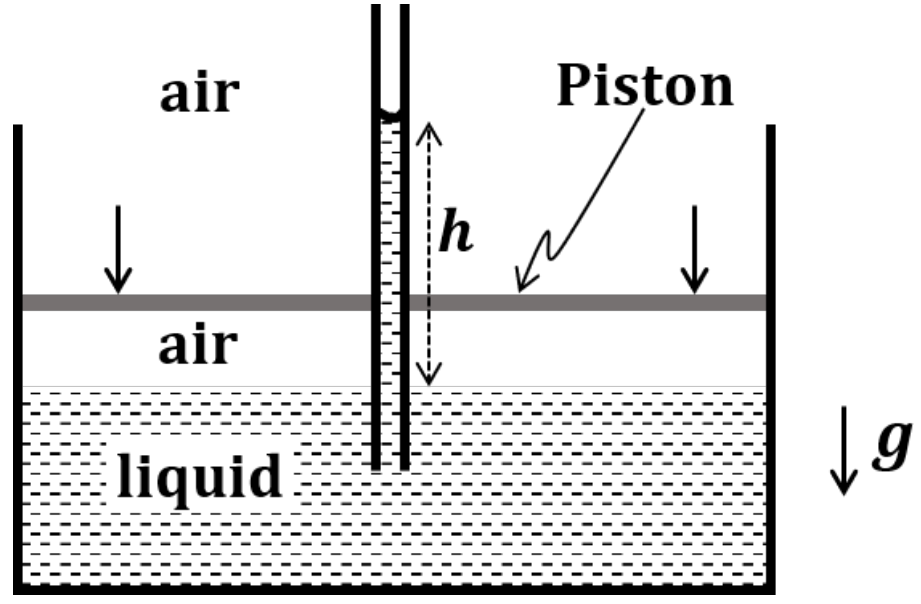
An incompressible liquid is kept in a container having a weightless piston with a hole. A capillary tube of inner radius is dipped vertically into the liquid through the airtight piston hole, as shown in the figure. The air in the container is isothermally compressed from its original volume to with the movable piston. Considering air as an ideal gas, the height () of the liquid column in the capillary above the liquid level in is _____.
[Given: Surface tension of the liquid is , atmospheric pressure is , acceleration due to gravity () is , density of the liquid is and contact angle of capillary surface with the liquid is zero]
Topics & Concepts
Step-by-Step Solution
To find the height of the liquid column in the capillary tube above the liquid level, we analyze the pressure equilibrium at the liquid surface inside the container.
Step 1: Compression of Air in the Container
Initially, the air inside the container is at atmospheric pressure and occupies a volume .
The air is isothermally compressed to a final volume . Using Boyle's Law () for an isothermal process:
Solving for the new air pressure inside the container:
Thus, the excess air pressure inside the container above atmospheric pressure is:
Step 2: Pressure Balance in the Capillary Tube
The top end of the capillary tube is open to the atmosphere, so the pressure at the surface of the meniscus inside the capillary tube is atmospheric pressure .
Due to surface tension and a contact angle of , the meniscus is concave upwards. The pressure drop across the spherical liquid meniscus is given by:
Given:
- Surface tension,
- Capillary inner radius,
Calculating the pressure drop across the meniscus:
Therefore, the pressure just below the liquid meniscus inside the capillary is:
The pressure at the level of the liquid surface inside the container, but inside the capillary tube, is given by adding the hydrostatic pressure of the liquid column of height :
Step 3: Solving for the Column Height
By hydrostatic equilibrium, the pressure inside the capillary tube at the liquid level must equal the air pressure pressing on the liquid surface outside the capillary:
Rearranging the terms:
Substitute the given and calculated values:
Converting into centimeters:
Final Answer: The height of the liquid column in the capillary above the liquid level is 25.