JEE Challenger
More from Waves

Beat Frequency Variation for Moving Observer between Sound Sources

Two sound sources MM and NN are positioned 20 m20\text{ m} apart and broadcast sound at frequencies 118 Hz118\text{ Hz} and 121 Hz121\text{ Hz}, respectively. A car initially at point PP, located 1800 m1800\text{ m} from the midpoint QQ of line segment MNMN, travels toward QQ at a constant speed of 60 km/h60\text{ km/h} along the perpendicular bisector of MNMN. It passes QQ and eventually reaches point RR, which is 1800 m1800\text{ m} away from QQ. Let ν(t)\nu(t) denote the beat frequency detected by an observer inside the vehicle at time tt. Let νP\nu_P, νQ\nu_Q, and νR\nu_R be the beat frequencies detected at locations PP, QQ, and RR, respectively. The speed of sound in air is 330 m s−1330\text{ m s}^{-1}. Which of the following statements is/are correct concerning the sound perceived by the observer?

Options

A

νP+νR=2νQ\nu_P + \nu_R = 2 \nu_Q

Correct
B

The rate of change of beat frequency reaches its maximum value as the car moves through point QQ.

Correct
C

The curve shown below schematically depicts the variation of beat frequency with time:
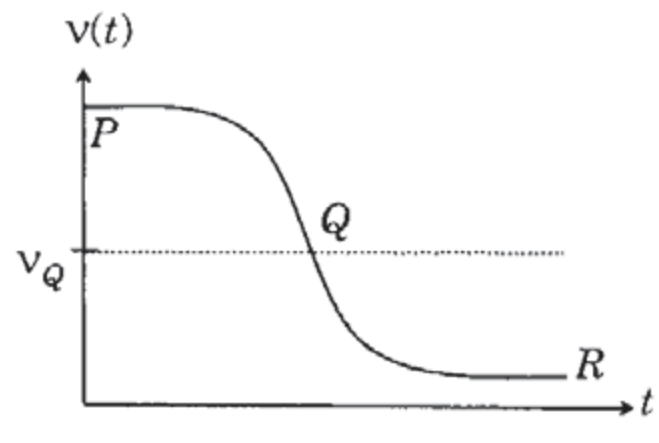
Option C
Correct
D

The curve shown below schematically depicts the variation of beat frequency with time:
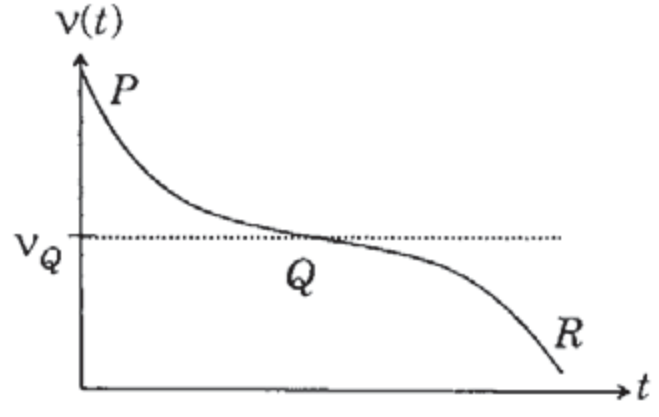
Option D

Step-by-Step Solution

To determine the correct statements, let us analyze the Doppler effect on the frequencies heard by the observer moving in the car.

1. Geometry and Coordinate Setup

Let the midpoint QQ of the line segment MNMN be at the origin (0,0)(0,0). The two sound sources MM and NN are positioned at coordinates: M=(0,d)andN=(0,−d)M = (0, d) \quad \text{and} \quad N = (0, -d) where 2d=20 m  ⟹  d=10 m2d = 20\text{ m} \implies d = 10\text{ m}.

The car moves along the perpendicular bisector (the xx-axis) from P(−1800 m,0)P(-1800\text{ m}, 0) through Q(0,0)Q(0,0) to R(1800 m,0)R(1800\text{ m}, 0) at a constant speed v0=60 km/h=503 m s−1v_0 = 60\text{ km/h} = \frac{50}{3}\text{ m s}^{-1}.

At any instant, let the position of the observer be (x,0)(x, 0). The speed of sound is vs=330 m s−1v_s = 330\text{ m s}^{-1}.

2. Doppler Shifted Frequencies

The unit vector directed from MM to the observer at (x,0)(x,0) is: r^M=xi^−dj^x2+d2\hat{r}_M = \frac{x\hat{i} - d\hat{j}}{\sqrt{x^2 + d^2}}

The velocity vector of the observer is: v⃗=v0i^\vec{v} = v_0 \hat{i}

The apparent frequency fM′f_M' received from source MM (frequency fM=118 Hzf_M = 118\text{ Hz}) is: fM′=fM(1−v⃗⋅r^Mvs)=fM(1−v0vsxx2+d2)f_M' = f_M \left( 1 - \frac{\vec{v} \cdot \hat{r}_M}{v_s} \right) = f_M \left( 1 - \frac{v_0}{v_s} \frac{x}{\sqrt{x^2 + d^2}} \right)

Similarly, for source NN (frequency fN=121 Hzf_N = 121\text{ Hz}): fN′=fN(1−v0vsxx2+d2)f_N' = f_N \left( 1 - \frac{v_0}{v_s} \frac{x}{\sqrt{x^2 + d^2}} \right)

3. Beat Frequency

The beat frequency detected by the observer at position xx is given by: ν(x)=∣fN′−fM′∣=(fN−fM)(1−v0vsxx2+d2)\nu(x) = |f_N' - f_M'| = (f_N - f_M) \left( 1 - \frac{v_0}{v_s} \frac{x}{\sqrt{x^2 + d^2}} \right)

Let Δf=fN−fM=121−118=3 Hz\Delta f = f_N - f_M = 121 - 118 = 3\text{ Hz}. Thus, ν(x)=Δf(1−v0vsxx2+d2)\nu(x) = \Delta f \left( 1 - \frac{v_0}{v_s} \frac{x}{\sqrt{x^2 + d^2}} \right)


Evaluation of Statements

Statement (A):

At position PP, x=−x0=−1800 mx = -x_0 = -1800\text{ m}: νP=Δf(1+v0vsx0x02+d2)\nu_P = \Delta f \left( 1 + \frac{v_0}{v_s} \frac{x_0}{\sqrt{x_0^2 + d^2}} \right)

At position QQ, x=0x = 0: νQ=Δf(1−0)=Δf\nu_Q = \Delta f (1 - 0) = \Delta f

At position RR, x=x0=1800 mx = x_0 = 1800\text{ m}: νR=Δf(1−v0vsx0x02+d2)\nu_R = \Delta f \left( 1 - \frac{v_0}{v_s} \frac{x_0}{\sqrt{x_0^2 + d^2}} \right)

Adding νP\nu_P and νR\nu_R: νP+νR=Δf(1+v0vsx0x02+d2)+Δf(1−v0vsx0x02+d2)=2Δf=2νQ\nu_P + \nu_R = \Delta f \left( 1 + \frac{v_0}{v_s} \frac{x_0}{\sqrt{x_0^2 + d^2}} \right) + \Delta f \left( 1 - \frac{v_0}{v_s} \frac{x_0}{\sqrt{x_0^2 + d^2}} \right) = 2 \Delta f = 2 \nu_Q Thus, Statement (A) is correct.


Statement (B):

The rate of change of beat frequency with respect to time tt is: dνdt=dνdx⋅dxdt=v0dνdx\frac{d\nu}{dt} = \frac{d\nu}{dx} \cdot \frac{dx}{dt} = v_0 \frac{d\nu}{dx}

Differentiating ν(x)\nu(x) with respect to xx: dνdx=−Δfv0vsddx(xx2+d2)=−Δfv0vsd2(x2+d2)3/2\frac{d\nu}{dx} = -\Delta f \frac{v_0}{v_s} \frac{d}{dx} \left( \frac{x}{\sqrt{x^2 + d^2}} \right) = -\Delta f \frac{v_0}{v_s} \frac{d^2}{(x^2 + d^2)^{3/2}}

Therefore: dνdt=−Δfv02d2vs(x2+d2)3/2\frac{d\nu}{dt} = -\Delta f \frac{v_0^2 d^2}{v_s (x^2 + d^2)^{3/2}}

elements in the magnitude of rate of change: ∣dνdt∣=Δfv02d2vs(x2+d2)3/2\left| \frac{d\nu}{dt} \right| = \frac{\Delta f v_0^2 d^2}{v_s (x^2 + d^2)^{3/2}}

This magnitude attains its maximum value when the denominator (x2+d2)3/2(x^2 + d^2)^{3/2} is minimized, which occurs at x=0x = 0 (point QQ). Thus, Statement (B) is correct.


Statements (C) and (D):

From the expression of dνdt\frac{d\nu}{dt}:

  1. Far away from QQ (at points PP and RR), x=±1800 m≫dx = \pm 1800\text{ m} \gg d, making ∣dνdt∣≈0\left| \frac{d\nu}{dt} \right| \approx 0. Hence, the slope of ν(t)\nu(t) vs tt curve is nearly horizontal near PP and RR.
  2. At QQ (x=0x = 0), the negative slope dνdt\frac{d\nu}{dt} has its maximum magnitude (steepest decay).

This indicates an SS-shaped (sigmoid) curve with an inflection point at QQ, which matches the schematic curve shown in option C.

Thus, Statement (C) is correct and Statement (D) is incorrect.