JEE Challenger
More from Current Electricity

Balanced Bridge with Tapered Wire Resistivity Ratio

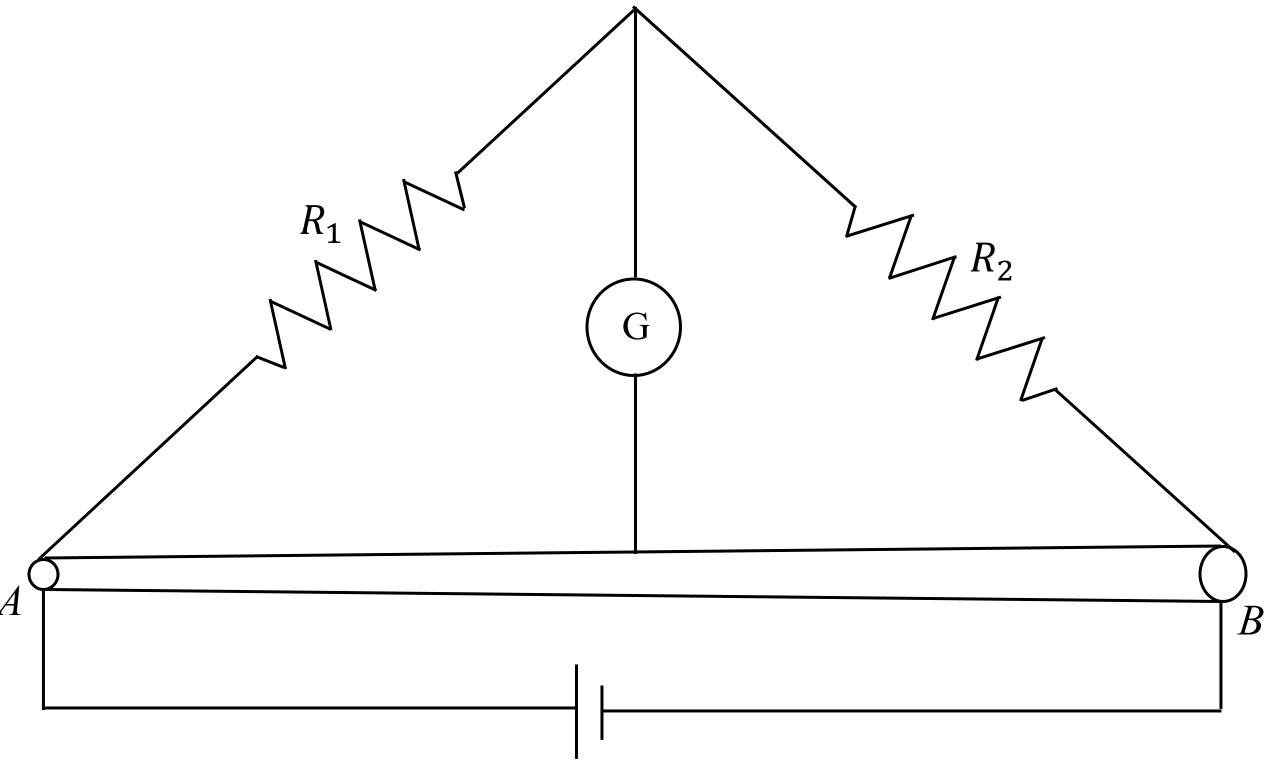
Two resistances R1=X ΩR_1 = X\ \Omega and R2=1 ΩR_2 = 1\ \Omega are connected to a wire ABAB of uniform resistivity, as shown in the figure. The radius of the wire varies linearly along its axis from 0.2 mm0.2\text{ mm} at AA to 1 mm1\text{ mm} at BB. A galvanometer (G) connected to the center of the wire, 50 cm50\text{ cm} from each end along its axis, shows zero deflection when AA and BB are connected to a battery. The value of XX is _____.

Question Diagram 1
Official Numerical Answer5

Step-by-Step Solution

To find the value of XX, we model the circuit as a balanced Wheatstone bridge.

1. Condition for Zero Deflection

For zero deflection in the galvanometer connected at the center CC of the wire (where AC=CB=50 cmAC = CB = 50\text{ cm}), the bridge must be balanced: R1R2=RACRCB\frac{R_1}{R_2} = \frac{R_{AC}}{R_{CB}}

Given R1=X ΩR_1 = X\ \Omega and R2=1 ΩR_2 = 1\ \Omega: X=RACRCBX = \frac{R_{AC}}{R_{CB}}


2. Resistance of a Linearly Tapered Wire Segment

Consider a wire segment of length ll whose radius varies linearly along its length from an initial radius rir_i to a final radius rfr_f.

At a distance xx from one end (0≤x≤l0 \le x \le l), the radius r(x)r(x) is given by: r(x)=ri+(rf−ril)xr(x) = r_i + \left(\frac{r_f - r_i}{l}\right)x

The differential resistance dRdR of a thin elemental slice of length dxdx is: dR=ρ dxπ[r(x)]2dR = \frac{\rho \, dx}{\pi [r(x)]^2}

Integrating from x=0x = 0 to x=lx = l: R=∫0lρ dxπ[ri+(rf−ril)x]2R = \int_0^l \frac{\rho \, dx}{\pi \left[r_i + \left(\frac{r_f - r_i}{l}\right)x\right]^2}

Substituting u=r(x)u = r(x), so du=rf−rildxdu = \frac{r_f - r_i}{l} dx: R=ρlπ(rf−ri)∫rirfduu2=ρlπ(rf−ri)[−1u]rirf=ρlπrirfR = \frac{\rho l}{\pi(r_f - r_i)} \int_{r_i}^{r_f} \frac{du}{u^2} = \frac{\rho l}{\pi(r_f - r_i)} \left[ -\frac{1}{u} \right]_{r_i}^{r_f} = \frac{\rho l}{\pi r_i r_f}


3. Calculating RACR_{AC} and RCBR_{CB}

Let:

  • rA=0.2 mmr_A = 0.2\text{ mm}
  • rB=1.0 mmr_B = 1.0\text{ mm}
  • rCr_C be the radius at the midpoint CC. Since the radius varies linearly, rC=rA+rB2=0.6 mmr_C = \frac{r_A + r_B}{2} = 0.6\text{ mm}.
  • l1=l2=50 cm=ll_1 = l_2 = 50\text{ cm} = l

Using the derived formula for resistance: RAC=ρlπrArCR_{AC} = \frac{\rho l}{\pi r_A r_C} RCB=ρlπrCrBR_{CB} = \frac{\rho l}{\pi r_C r_B}


4. Finding XX

Taking the ratio of RACR_{AC} to RCBR_{CB}: RACRCB=ρlπrArCρlπrCrB=rBrA\frac{R_{AC}}{R_{CB}} = \frac{\frac{\rho l}{\pi r_A r_C}}{\frac{\rho l}{\pi r_C r_B}} = \frac{r_B}{r_A}

Substituting the given values of rAr_A and rBr_B: X=1.0 mm0.2 mm=5X = \frac{1.0\text{ mm}}{0.2\text{ mm}} = 5

Balanced Bridge with Tapered Wire Resistivity Ratio | Physics PYQ Solution - JEE Challenger