Average Current Dependence on Voltage in Charging Cylindrical Chamber
Consider an evacuated cylindrical chamber of height having rigid conducting plates at the ends and an insulating curved surface as shown in the figure. A number of spherical balls made of a light weight and soft material and coated with a conducting material are placed on the bottom plate. The balls have a radius . Now a high voltage source (HV) is connected across the conducting plates such that the bottom plate is at and the top plate at . Due to their conducting surface, the balls will get charged, will become equipotential with the plate and are repelled by it. The balls will eventually collide with the top plate, where the coefficient of restitution can be taken to be zero due to the soft nature of the material of the balls. The electric field in the chamber can be considered to be that of a parallel plate capacitor. Assume that there are no collisions between the balls and the interaction between them is negligible. (Ignore gravity)
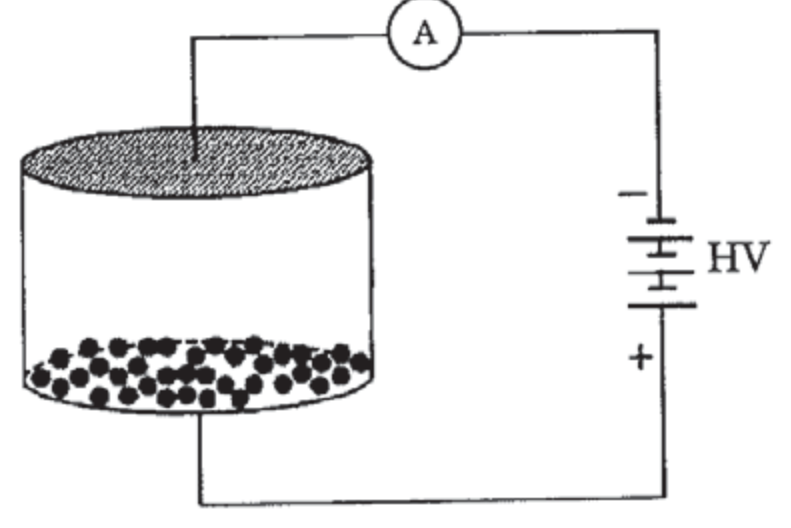
In the steady state, the average current registered by the circuit's ammeter is:
Options
zero
proportional to the potential
proportional to
proportional to
Topics & Concepts
Step-by-Step Solution
To determine the dependence of the average current on the potential in the steady state, we analyze the charge acquired by the balls and their motion between the plates.
1. Electric Field in the Chamber
The bottom plate is maintained at potential and the top plate at . The potential difference across the height of the cylindrical chamber is:
Assuming the electric field inside the chamber is uniform (similar to a parallel plate capacitor): Thus, the electric field is directly proportional to :
2. Charge Acquired by a Ball
When a conducting spherical ball of radius comes into contact with a conducting plate placed in a uniform electric field , it acquires a charge given by: Since , the charge acquired by each ball is directly proportional to :
3. Acceleration and Time of Flight
The electrostatic force acting on a ball of mass carrying charge in the field is: Substituting the proportionalities and :
Ignoring gravity, the acceleration of the ball is:
Since the coefficient of restitution is zero, the ball comes to rest relative to the plate upon impact, recharges to the plate's potential, and then accelerates from rest () towards the opposite plate.
The time taken by the ball to traverse the distance between the plates is obtained from: Since , the time of flight scales as:
4. Average Current
The average current in the circuit is proportional to the rate of charge transferred by the balls between the plates:
Substituting and :
Thus, the average current registered by the ammeter in the steady state is proportional to .
Correct Option: (D)