Angular Speed of Rotating Disc Driven by Internal Motor
A disc of mass and radius is free to rotate about its vertical axis as shown in the figure. A battery operated motor of negligible mass is fixed to this disc at a point on its circumference. Another disc of the same mass and radius is fixed to the motor's thin shaft. Initially, both the discs are at rest. The motor is switched on so that the smaller disc rotates at a uniform angular speed . If the angular speed at which the large disc rotates is , then the value of is ______.
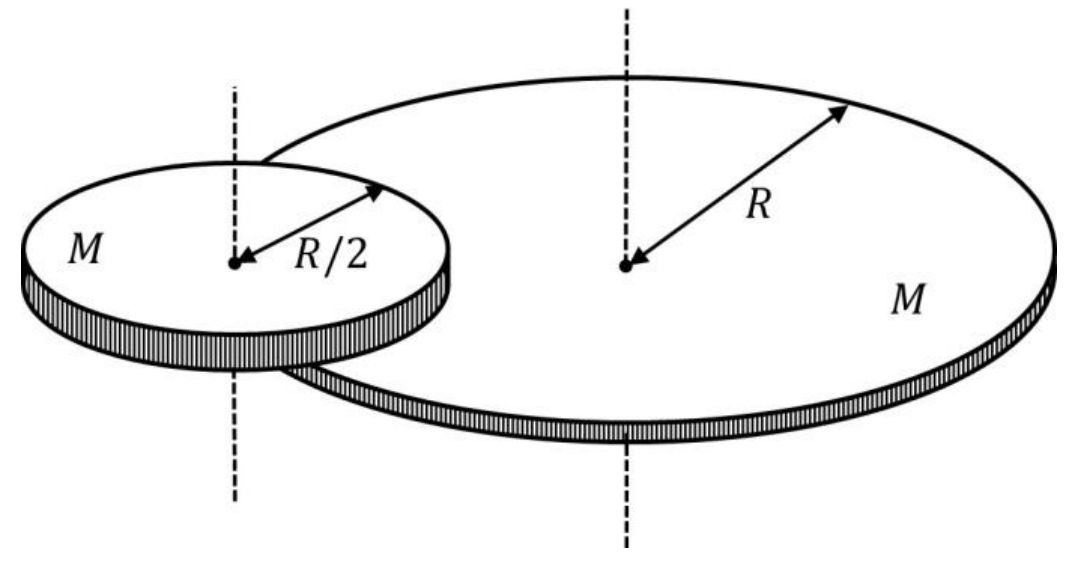
Step-by-Step Solution
To find the angular speed of the large disc, we apply the principle of Conservation of Angular Momentum about the vertical rotation axis passing through the center of the large disc.
1. Parameters and Moments of Inertia
-
Large Disc:
- Mass = , Radius =
- Moment of inertia about its vertical central axis:
-
Small Disc:
- Mass = , Radius =
- Moment of inertia about its own center of mass:
- Distance of the small disc's center of mass from the main vertical axis = .
2. Angular Momentum Calculation
Let the angular velocity of the large disc about its central axis in the ground frame be .
-
Angular momentum of the large disc:
-
Angular momentum of the small disc: The motion of the small disc consists of the translation of its center of mass in a circle of radius about the central axis, plus rotation about its own center of mass.
- Orbital angular momentum of its center of mass:
- Spin angular momentum about its center of mass: where is the absolute angular velocity of the small disc in the ground frame.
Thus, the total angular momentum of the small disc about the central axis is:
3. Conservation of Angular Momentum
Since no external torque acts on the system about the vertical axis:
4. Determining and
Case 1: is relative to the motor (large disc)
Since the motor is mounted on the large disc, the uniform angular speed produced by the motor is relative to the large disc. Thus, the absolute angular velocity of the small disc is:
Substituting into the conservation equation:
Comparing with , we get:
Case 2: is relative to the ground frame
If represents the absolute angular speed of the small disc ():
Comparing with , we get:
Final Answer
Taking the physical interpretation of an internal motor driving the shaft relative to its base disc, the value of is 13 (or 12 if is specified with respect to the ground frame).