Angular Speed of Circular Disc Under Applied Forces
A uniform circular disc of mass and radius is initially at rest on a frictionless horizontal plane. Three forces, each of magnitude , are applied simultaneously along the sides of an equilateral triangle whose vertices lie on the circumference of the disc (as shown in the figure). One second after applying these forces, the angular speed of the disc in is
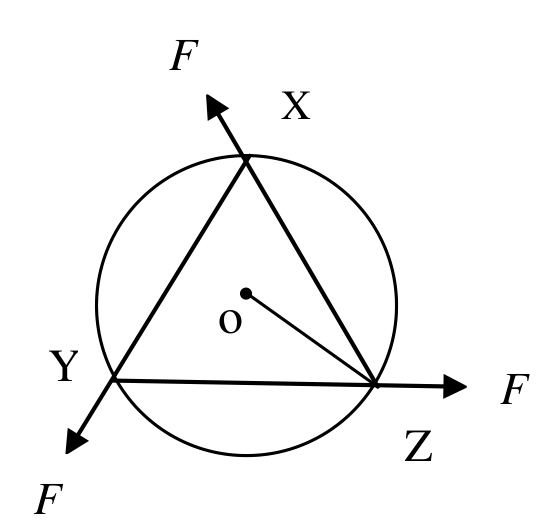
Topics & Concepts
Step-by-Step Solution
To find the angular speed of the circular disc after , we analyze the net force and net torque acting on the disc.
1. Geometry of the Setup
For an equilateral triangle inscribed in a circular disc of radius , the perpendicular distance from the center of the disc to any side of the triangle is given by:
2. Net Force and Net Torque
Three forces of equal magnitude act along the three sides of the equilateral triangle in a cyclic order.
Since the forces are of equal magnitude and their directions are inclined at with respect to one another, the vector sum of these forces is zero:
Therefore, the center of mass of the disc does not accelerate and remains at rest. The system undergoes pure rotation about its center of mass.
Each force exerts a torque in the same rotational sense about the center . The total torque about the center of the disc is:
3. Angular Acceleration
The moment of inertia of a uniform circular disc of mass and radius about its central axis perpendicular to its plane is:
Using the rotational analogue of Newton's second law (), the angular acceleration is:
Substituting the given values (, , ):
4. Angular Speed
Starting from rest (), the angular speed after is: