JEE Challenger
More from System of Particles and Rotational Motion

Angular Momentum Variation for Circular Motion About Different Points

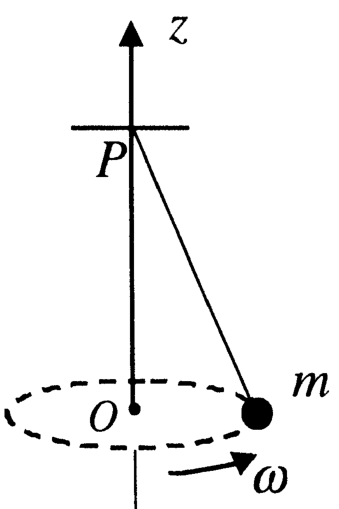
A small body of mass mm is connected to a light string fixed at point PP, as depicted in the diagram. The particle executes circular motion in the xx-yy plane centered at OO with uniform angular speed ω\omega. If L⃗O\vec{L}_O and L⃗P\vec{L}_P represent the angular momentum vectors of the mass evaluated about points OO and PP respectively, then

Question Diagram 1

Options

A

L⃗O\vec{L}_O and L⃗P\vec{L}_P do not vary with time.

B

L⃗O\vec{L}_O varies with time while L⃗P\vec{L}_P remains constant.

C

L⃗O\vec{L}_O remains constant while L⃗P\vec{L}_P varies with time.

Correct
D

L⃗O\vec{L}_O and L⃗P\vec{L}_P both vary with time.

Step-by-Step Solution

To determine how the angular momentum vectors L⃗O\vec{L}_O and L⃗P\vec{L}_P vary with time, we analyze the position and velocity vectors of the particle in a Cartesian coordinate system.

Let the origin of the coordinate system be at the center of the circular path O(0,0,0)O(0, 0, 0), with the circular motion occurring in the xx-yy plane. Point PP lies on the zz-axis at a height hh above OO, so its coordinates are (0,0,h)(0, 0, h).

1. Motion of the Particle

For a particle of mass mm executing uniform circular motion of radius RR in the xx-yy plane with constant angular speed ω\omega, its position vector relative to OO at any time tt is given by: r⃗O=Rcos⁡(ωt)i^+Rsin⁡(ωt)j^\vec{r}_O = R\cos(\omega t)\hat{i} + R\sin(\omega t)\hat{j}

The linear velocity v⃗\vec{v} of the particle is the time derivative of r⃗O\vec{r}_O: v⃗=dr⃗Odt=−Rωsin⁡(ωt)i^+Rωcos⁡(ωt)j^\vec{v} = \frac{d\vec{r}_O}{dt} = -R\omega\sin(\omega t)\hat{i} + R\omega\cos(\omega t)\hat{j}


2. Angular Momentum about Point OO (L⃗O\vec{L}_O)

The angular momentum about the center OO is defined as: L⃗O=r⃗O×(mv⃗)\vec{L}_O = \vec{r}_O \times (m\vec{v})

Substituting r⃗O\vec{r}_O and v⃗\vec{v}: L⃗O=m[(Rcos⁡(ωt)i^+Rsin⁡(ωt)j^)×(−Rωsin⁡(ωt)i^+Rωcos⁡(ωt)j^)]\vec{L}_O = m \left[ \left( R\cos(\omega t)\hat{i} + R\sin(\omega t)\hat{j} \right) \times \left( -R\omega\sin(\omega t)\hat{i} + R\omega\cos(\omega t)\hat{j} \right) \right]

Evaluating the cross product using standard unit vector relations (i^×j^=k^\hat{i} \times \hat{j} = \hat{k}, j^×i^=−k^\hat{j} \times \hat{i} = -\hat{k}): L⃗O=mR2ω[cos⁡2(ωt)+sin⁡2(ωt)]k^=mR2ωk^\vec{L}_O = m R^2 \omega \left[ \cos^2(\omega t) + \sin^2(\omega t) \right] \hat{k} = m R^2 \omega \hat{k}

Since mm, RR, ω\omega, and the direction k^\hat{k} are all independent of time, L⃗O\vec{L}_O remains constant in both magnitude and direction.


3. Angular Momentum about Point PP (L⃗P\vec{L}_P)

The position vector of the particle relative to point P(0,0,h)P(0,0,h) is: r⃗P=r⃗O−hk^=Rcos⁡(ωt)i^+Rsin⁡(ωt)j^−hk^\vec{r}_P = \vec{r}_O - h\hat{k} = R\cos(\omega t)\hat{i} + R\sin(\omega t)\hat{j} - h\hat{k}

The angular momentum about PP is: L⃗P=r⃗P×(mv⃗)\vec{L}_P = \vec{r}_P \times (m\vec{v})

Using the determinant form for the cross product:

L⃗P=m∣i^j^k^Rcos⁡(ωt)Rsin⁡(ωt)−h−Rωsin⁡(ωt)Rωcos⁡(ωt)0∣\vec{L}_P = m \begin{vmatrix} \hat{i} & \hat{j} & \hat{k} \\ R\cos(\omega t) & R\sin(\omega t) & -h \\ -R\omega\sin(\omega t) & R\omega\cos(\omega t) & 0 \end{vmatrix}

Expanding the determinant: L⃗P=m[i^(0−(−hRωcos⁡(ωt)))−j^(0−(−hRωsin⁡(ωt)))+k^(R2ωcos⁡2(ωt)+R2ωsin⁡2(ωt))]\vec{L}_P = m \left[ \hat{i}\left( 0 - (-h R\omega\cos(\omega t)) \right) - \hat{j}\left( 0 - (-h R\omega\sin(\omega t)) \right) + \hat{k}\left( R^2\omega\cos^2(\omega t) + R^2\omega\sin^2(\omega t) \right) \right]

L⃗P=(mhRωcos⁡(ωt))i^+(mhRωsin⁡(ωt))j^+(mR2ω)k^\vec{L}_P = (m h R \omega \cos(\omega t))\hat{i} + (m h R \omega \sin(\omega t))\hat{j} + (m R^2 \omega)\hat{k}

While the magnitude of L⃗P\vec{L}_P is constant: ∣L⃗P∣=(mhRω)2+(mR2ω)2|\vec{L}_P| = \sqrt{(m h R \omega)^2 + (m R^2 \omega)^2}

its direction continuously changes with time as it precesses around the zz-axis. Therefore, L⃗P\vec{L}_P varies with time.


Conclusion

L⃗O\vec{L}_O remains constant while L⃗P\vec{L}_P varies with time.

Correct Option: C