Angular Momentum of Rotating Rod and Disc System About Fixed Axis
A thin rod with mass and length can rotate in a horizontal plane around a fixed vertical axis passing through point O. A thin circular disc of mass and radius is mounted on the rod such that its center is at a distance from the rod's free end, allowing it to rotate freely about its own vertical axis as depicted in the figure. Assume uniform density for both the rod and disc and that they remain horizontal throughout the movement. A stationary external observer observes the rod spinning with angular velocity and the disc spinning about its vertical axis with angular velocity . If the net angular momentum of the system about point O is expressed as , find the value of .
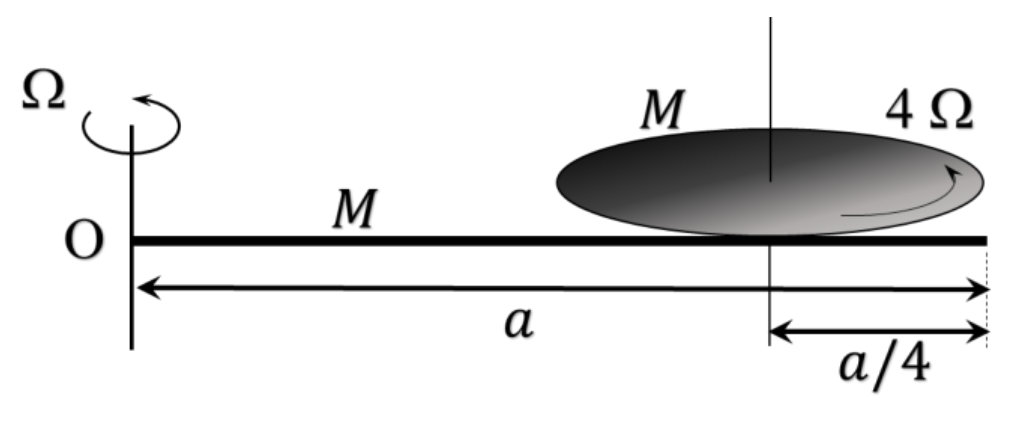
Step-by-Step Solution
To find the total angular momentum of the system about the fixed vertical axis passing through point , we can compute the angular momentum of the rod and the disc separately and sum them up using the principle of superposition of angular momentum.
1. Angular Momentum of the Rod ()
The thin uniform rod has mass and length . It rotates about a fixed vertical axis passing through one of its ends (point ) with an angular velocity .
The moment of inertia of the rod about this axis is:
Therefore, the angular momentum of the rod about point is:
2. Angular Momentum of the Disc ()
The total angular momentum of a rotating rigid body about a fixed point can be decomposed into two components:
(a) Orbital Angular Momentum ():
The center of mass of the circular disc is located at a distance from point equal to:
Since the center of mass rotates about point with angular velocity , the magnitude of the orbital angular momentum of the disc's center of mass is:
(b) Spin Angular Momentum ():
The disc has a radius and mass . Its moment of inertia about its own vertical center of mass axis is:
As observed by a stationary external observer, the disc spins about its vertical axis with an angular velocity of in the same direction as . Therefore, the spin angular momentum is:
3. Total Angular Momentum of the System ()
Since all rotation vectors are aligned along the same vertical axis, the net angular momentum about point is the scalar sum of all the individual terms:
Finding a common denominator of :
Comparing this expression to the given form :