Analysis of Organic Reaction Sequence involving Succinic Anhydride and Friedel-Crafts Acylation
Based on the reaction sequence provided below, select the correct statement(s):
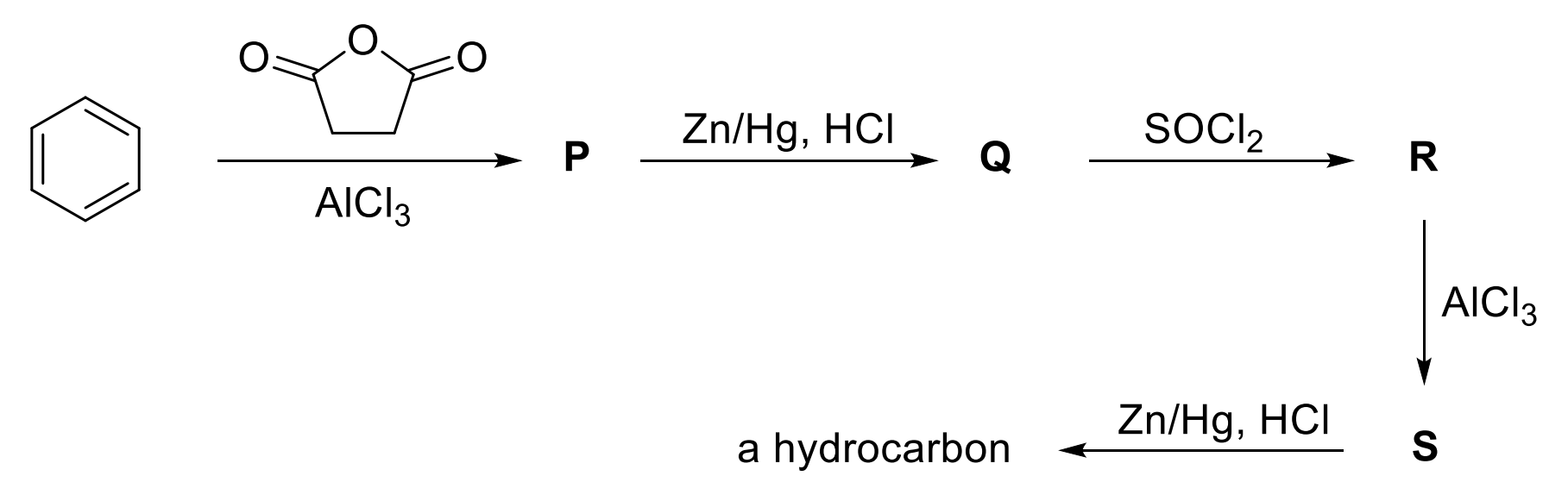
Options
Compounds and are classified as carboxylic acids.
Compound decolorizes bromine water.
Compounds and readily react with hydroxylamine to form oxime derivatives.
Compound reacts with dialkylcadmium to produce the corresponding tertiary alcohol.
Step-by-Step Solution
To determine the correct statement(s), let us analyze the reaction sequence step-by-step:
Step 1: Identification of Compounds , , , and
-
Formation of Compound : Benzene undergoes Friedel-Crafts acylation with succinic anhydride in the presence of anhydrous to form -benzoylpropionic acid (4-oxo-4-phenylbutanoic acid).
-
Formation of Compound : Compound undergoes Clemmensen reduction using zinc amalgam () and concentrated . The keto carbonyl group () is reduced to a methylene group (), yielding 4-phenylbutanoic acid.
-
Formation of Compound : Compound reacts with thionyl chloride (), converting the carboxylic acid group () into an acyl chloride group () to form 4-phenylbutanoyl chloride.
-
Formation of Compound : Compound undergoes intramolecular Friedel-Crafts acylation in the presence of anhydrous to yield a six-membered cyclic ketone, 1-tetralone (-tetralone, or 3,4-dihydronaphthalen-1(2H)-one).
-
Further Reduction (Hydrocarbon): Compound (1-tetralone) is reduced via Clemmensen reduction () to yield tetralin (1,2,3,4-tetrahydronaphthalene), which is a hydrocarbon.
Step 2: Analysis of the Options
-
Option (A):
- Compound () contains a carboxylic acid group ().
- Compound () also contains a carboxylic acid group ().
- Statement (A) is CORRECT.
-
Option (B):
- Compound is 1-tetralone, a stable ketone containing an aromatic ring. It lacks aliphatic alkenes or alkynes and is not activated sufficiently to decolorize bromine water.
- Statement (B) is INCORRECT.
-
Option (C):
- Compound has a ketone carbonyl group ().
- Compound (1-tetralone) is a cyclic ketone containing a carbonyl group ().
- Ketones react readily with hydroxylamine () to yield oximes ().
- Statement (C) is CORRECT.
-
Option (D):
- Compound is an acyl chloride ().
- Acyl chlorides react with dialkylcadmium () to produce ketones (). Because dialkylcadmium is less nucleophilic than Grignard reagents, it does not react further with ketones to give tertiary alcohols.
- Statement (D) is INCORRECT.
Conclusion
The correct options are A and C.