JEE Challenger
More from System of Particles and Rotational Motion

Amount of Energy Loss in Off Center Disk Particle Collision

Comprehension Passage

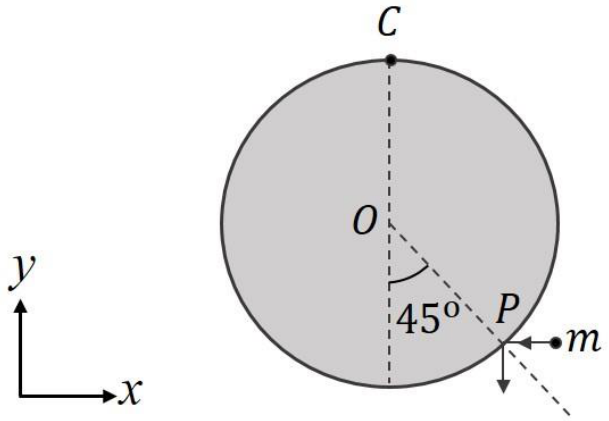
A uniform circular disk of radius 0.2 m0.2\text{ m} and mass 1 kg1\text{ kg} is pivoted at its top point CC such that it can rotate freely around CC in the XYXY plane, as shown in the figure. Initially, when the disk is at rest, a particle of mass 20 g20\text{ g}, travelling along negative xx direction in the XYXY plane with speed 100 ms1100\text{ ms}^{-1}, hits the circumference of the disk at a point PP. After collision the particle moves along negative yy direction at a speed of 90 ms190\text{ ms}^{-1}.

[Given: the acceleration due to gravity (g)=10j^ ms2(\text{g}) = - 10 \hat{j}\text{ ms}^{-2}]

Amount of energy loss (in J) in the collision is:

Question Diagram 1
Official Numerical Answer17 to 18

Step-by-Step Solution

To find the amount of energy lost during the collision, we analyze the angular momentum of the system about the fixed pivot point CC before and after the collision, followed by calculating the initial and final kinetic energies.

1. System Parameters and Coordinates

  • Mass of the disk: M=1 kgM = 1 \text{ kg}
  • Radius of the disk: R=0.2 mR = 0.2 \text{ m}
  • Mass of the particle: m=20 g=0.02 kgm = 20 \text{ g} = 0.02 \text{ kg}
  • Initial velocity of the particle: vi=100i^ ms1\vec{v}_i = -100 \hat{i} \text{ ms}^{-1}
  • Final velocity of the particle: vf=90j^ ms1\vec{v}_f = -90 \hat{j} \text{ ms}^{-1}

Taking the pivot point CC as the origin (0,0)(0,0) in the XYXY plane:

  • The center OO of the disk is located at (0,R)(0, -R).
  • Point PP on the circumference makes an angle of 4545^\circ with the vertical line passing through CC and OO.
  • Position vector of point PP relative to CC: rP=Rsin45i^(R+Rcos45)j^=R2i^R(1+12)j^\vec{r}_P = R \sin 45^\circ \hat{i} - \left(R + R \cos 45^\circ\right) \hat{j} = \frac{R}{\sqrt{2}} \hat{i} - R\left(1 + \frac{1}{\sqrt{2}}\right) \hat{j}

Substituting R=0.2 mR = 0.2 \text{ m}: rP=0.22i^0.2(1+12)j^\vec{r}_P = \frac{0.2}{\sqrt{2}} \hat{i} - 0.2\left(1 + \frac{1}{\sqrt{2}}\right) \hat{j}


2. Moment of Inertia of the Disk

By the parallel axis theorem, the moment of inertia of the uniform circular disk about the pivot point CC is: IC=ICM+MR2=12MR2+MR2=32MR2I_C = I_{\text{CM}} + M R^2 = \frac{1}{2} M R^2 + M R^2 = \frac{3}{2} M R^2

Substituting the values: IC=32(1)(0.2)2=0.06 kg m2I_C = \frac{3}{2} (1) (0.2)^2 = 0.06 \text{ kg m}^2


3. Conservation of Angular Momentum about Pivot CC

Since external forces during the short collision interval act at the pivot point CC, the angular momentum about CC is conserved:

Initial Angular Momentum (Li\vec{L}_i):

Li=rP×(mvi)\vec{L}_i = \vec{r}_P \times (m \vec{v}_i) Li=[R2i^R(1+12)j^]×(mv1i^)\vec{L}_i = \left[ \frac{R}{\sqrt{2}} \hat{i} - R\left(1 + \frac{1}{\sqrt{2}}\right) \hat{j} \right] \times \left( -m v_1 \hat{i} \right) Li=mv1R(1+12)k^\vec{L}_i = -m v_1 R\left(1 + \frac{1}{\sqrt{2}}\right) \hat{k}

Substituting m=0.02 kgm = 0.02 \text{ kg}, v1=100 ms1v_1 = 100 \text{ ms}^{-1}, and R=0.2 mR = 0.2 \text{ m}: Li,z=(0.02)(100)(0.2)(1+12)=0.4(1+12) kg m2s1L_{i, z} = -(0.02)(100)(0.2)\left(1 + \frac{1}{\sqrt{2}}\right) = -0.4\left(1 + \frac{1}{\sqrt{2}}\right) \text{ kg m}^2\text{s}^{-1}

Final Angular Momentum (Lf\vec{L}_f):

Lf=ICωk^+rP×(mvf)\vec{L}_f = I_C \omega \hat{k} + \vec{r}_P \times (m \vec{v}_f) rP×(mvf)=[R2i^R(1+12)j^]×(mv2j^)=mv2R2k^\vec{r}_P \times (m \vec{v}_f) = \left[ \frac{R}{\sqrt{2}} \hat{i} - R\left(1 + \frac{1}{\sqrt{2}}\right) \hat{j} \right] \times \left( -m v_2 \hat{j} \right) = -m v_2 \frac{R}{\sqrt{2}} \hat{k}

Substituting v2=90 ms1v_2 = 90 \text{ ms}^{-1}: Lp,f,z=(0.02)(90)0.22=0.362 kg m2s1L_{p, f, z} = -(0.02)(90) \frac{0.2}{\sqrt{2}} = -\frac{0.36}{\sqrt{2}} \text{ kg m}^2\text{s}^{-1}

Equating initial and final angular momentum along the zz-axis: ICω+Lp,f,z=Li,zI_C \omega + L_{p, f, z} = L_{i, z} 0.06ω=0.4(1+12)(0.362)0.06 \omega = -0.4\left(1 + \frac{1}{\sqrt{2}}\right) - \left(-\frac{0.36}{\sqrt{2}}\right) 0.06ω=0.40.0420.40.028284=0.428284 kg m2s10.06 \omega = -0.4 - \frac{0.04}{\sqrt{2}} \approx -0.4 - 0.028284 = -0.428284 \text{ kg m}^2\text{s}^{-1} ω=0.4282840.067.138 rad s1\omega = \frac{-0.428284}{0.06} \approx -7.138 \text{ rad s}^{-1}


4. Calculation of Kinetic Energy Loss

  • Initial Kinetic Energy (KiK_i): Ki=12mv12=12(0.02)(100)2=100 JK_i = \frac{1}{2} m v_1^2 = \frac{1}{2} (0.02) (100)^2 = 100 \text{ J}

  • Final Kinetic Energy (KfK_f): Kparticle,f=12mv22=12(0.02)(90)2=81 JK_{\text{particle}, f} = \frac{1}{2} m v_2^2 = \frac{1}{2} (0.02) (90)^2 = 81 \text{ J} Kdisk,f=12ICω2=12(0.06)(7.138)21.5285 JK_{\text{disk}, f} = \frac{1}{2} I_C \omega^2 = \frac{1}{2} (0.06) (-7.138)^2 \approx 1.5285 \text{ J} Kf=81+1.5285=82.5285 JK_f = 81 + 1.5285 = 82.5285 \text{ J}

  • Energy Loss (ΔE\Delta E): ΔE=KiKf=10082.5285=17.4715 J\Delta E = K_i - K_f = 100 - 82.5285 = 17.4715 \text{ J}

Thus, the amount of energy loss in the collision is approximately 17.47 J17.47 \text{ J} (or within the range 1717 to 18 J18 \text{ J}).

Amount of Energy Loss in Off Center Disk Particle Collision | Physics PYQ Solution - JEE Challenger