JEE Challenger
More from Aldehydes, Ketones and Carboxylic Acids

Amount of Calcium Soap Produced from Reaction of Glycerol and Compound P

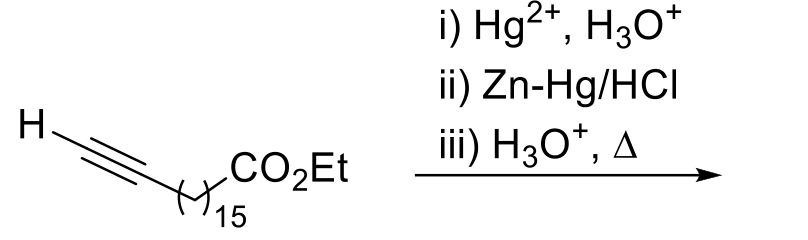
In the following reaction sequence, the major product P\mathbf{P} is formed.

Glycerol reacts completely with excess P\mathbf{P} in the presence of an acid catalyst to form Q\mathbf{Q}. Reaction of Q\mathbf{Q} with excess NaOH\text{NaOH} followed by the treatment with CaCl2\text{CaCl}_2 yields Ca-soap R\mathbf{R}, quantitatively. Starting with one mole of Q\mathbf{Q}, the amount of R\mathbf{R} produced in gram is _______.

[Given, atomic weight: H=1\text{H} = 1, C=12\text{C} = 12, N=14\text{N} = 14, O=16\text{O} = 16, Na=23\text{Na} = 23, Cl=35\text{Cl} = 35, Ca=40\text{Ca} = 40]

Question Diagram 1
Official Numerical Answer909

Step-by-Step Solution

To determine the mass of calcium soap (R\mathbf{R}) produced from 1 mole of Q\mathbf{Q}, we break down the reaction sequence step by step.


Step 1: Identification of Major Product P\mathbf{P}

The starting compound is ethyl octadec-17-ynoate: HCC(CH2)15CO2Et\text{HC}\equiv\text{C}-(\text{CH}_2)_{15}-\text{CO}_2\text{Et}

  1. Hydration (Hg2+,H3O+\text{Hg}^{2+}, \text{H}_3\text{O}^+): Oxymercuration-demercuration converts the terminal alkyne into a methyl ketone via Markovnikov addition: HCC(CH2)15CO2EtHg2+,H3O+CH3C(=O)(CH2)15CO2Et\text{HC}\equiv\text{C}-(\text{CH}_2)_{15}-\text{CO}_2\text{Et} \xrightarrow{\text{Hg}^{2+}, \text{H}_3\text{O}^+} \text{CH}_3-\text{C}(=\text{O})-(\text{CH}_2)_{15}-\text{CO}_2\text{Et}

  2. Clemmensen Reduction (Zn-Hg/HCl\text{Zn-Hg/HCl}): The carbonyl group (C(=O))(-\text{C}(=\text{O})-) is reduced to a methylene group (CH2)(-\text{CH}_2-): CH3C(=O)(CH2)15CO2EtZn-Hg/HClCH3CH2(CH2)15CO2Et=CH3(CH2)16CO2Et\text{CH}_3-\text{C}(=\text{O})-(\text{CH}_2)_{15}-\text{CO}_2\text{Et} \xrightarrow{\text{Zn-Hg/HCl}} \text{CH}_3-\text{CH}_2-(\text{CH}_2)_{15}-\text{CO}_2\text{Et} = \text{CH}_3-(\text{CH}_2)_{16}-\text{CO}_2\text{Et}

  3. Ester Hydrolysis (H3O+,Δ\text{H}_3\text{O}^+, \Delta): Acid-catalyzed hydrolysis of the ethyl ester yields stearic acid (P\mathbf{P}): CH3(CH2)16CO2EtH3O+,ΔCH3(CH2)16COOH+EtOH\text{CH}_3-(\text{CH}_2)_{16}-\text{CO}_2\text{Et} \xrightarrow{\text{H}_3\text{O}^+, \Delta} \text{CH}_3-(\text{CH}_2)_{16}-\text{COOH} + \text{EtOH}

Thus, compound P\mathbf{P} is stearic acid, CH3(CH2)16COOH\text{CH}_3(\text{CH}_2)_{16}\text{COOH} (molecular formula C18H36O2\text{C}_{18}\text{H}_{36}\text{O}_2).


Step 2: Formation of Compound Q\mathbf{Q}

Glycerol (C3H8O3\text{C}_3\text{H}_8\text{O}_3) reacts completely with excess stearic acid (P\mathbf{P}) in the presence of an acid catalyst to form a triglyceride Q\mathbf{Q} (glyceryl tristearate): C3H5(OH)3+3CH3(CH2)16COOHH+C3H5(OCO(CH2)16CH3)3+3H2O\text{C}_3\text{H}_5(\text{OH})_3 + 3\,\text{CH}_3(\text{CH}_2)_{16}\text{COOH} \xrightarrow{\text{H}^+} \text{C}_3\text{H}_5\left(\text{O}-\text{CO}-(\text{CH}_2)_{16}\text{CH}_3\right)_3 + 3\,\text{H}_2\text{O}


Step 3: Saponification and Precipitation of Ca-Soap R\mathbf{R}

  1. Saponification with excess NaOH\text{NaOH}: 1 mole of triglyceride Q\mathbf{Q} yields 3 moles of sodium stearate (CH3(CH2)16COONa\text{CH}_3(\text{CH}_2)_{16}\text{COONa}): Q+3NaOHGlycerol+3CH3(CH2)16COONa\mathbf{Q} + 3\,\text{NaOH} \rightarrow \text{Glycerol} + 3\,\text{CH}_3(\text{CH}_2)_{16}\text{COONa}

  2. Precipitation with CaCl2\text{CaCl}_2: 3 moles of sodium stearate react quantitatively with CaCl2\text{CaCl}_2 to form calcium stearate (R\mathbf{R}): 3CH3(CH2)16COONa+32CaCl232[CH3(CH2)16COO]2Ca+3NaCl3\,\text{CH}_3(\text{CH}_2)_{16}\text{COONa} + \frac{3}{2}\,\text{CaCl}_2 \rightarrow \frac{3}{2}\left[\text{CH}_3(\text{CH}_2)_{16}\text{COO}\right]_2\text{Ca} + 3\,\text{NaCl}

Therefore, starting with 1 mole1\text{ mole} of Q\mathbf{Q}, the amount of calcium soap R\mathbf{R} produced is 1.5 moles1.5\text{ moles}.


Step 4: Molar Mass and Final Amount of R\mathbf{R}

  • Molar mass of stearate ion (C18H35O2)(\text{C}_{18}\text{H}_{35}\text{O}_2^-): Mstearate=(18×12)+(35×1)+(2×16)=216+35+32=283 g/mol\text{M}_{\text{stearate}} = (18 \times 12) + (35 \times 1) + (2 \times 16) = 216 + 35 + 32 = 283\text{ g/mol}

  • Molar mass of calcium stearate R\mathbf{R}, [C18H35O2]2Ca\left[\text{C}_{18}\text{H}_{35}\text{O}_2\right]_2\text{Ca}: MR=(2×283)+40=566+40=606 g/mol\text{M}_{\mathbf{R}} = (2 \times 283) + 40 = 566 + 40 = 606\text{ g/mol}

  • Mass of R\mathbf{R} produced: Mass of R=1.5 mol×606 g/mol=909 g\text{Mass of } \mathbf{R} = 1.5\text{ mol} \times 606\text{ g/mol} = 909\text{ g}

Final Answer: The amount of R\mathbf{R} produced in gram is 909.