JEE Challenger
More from Organic Chemistry - Basic Principles

Amount of Barium Sulfate Formed in Carius Method of Sulphur Estimation

Comprehension Passage

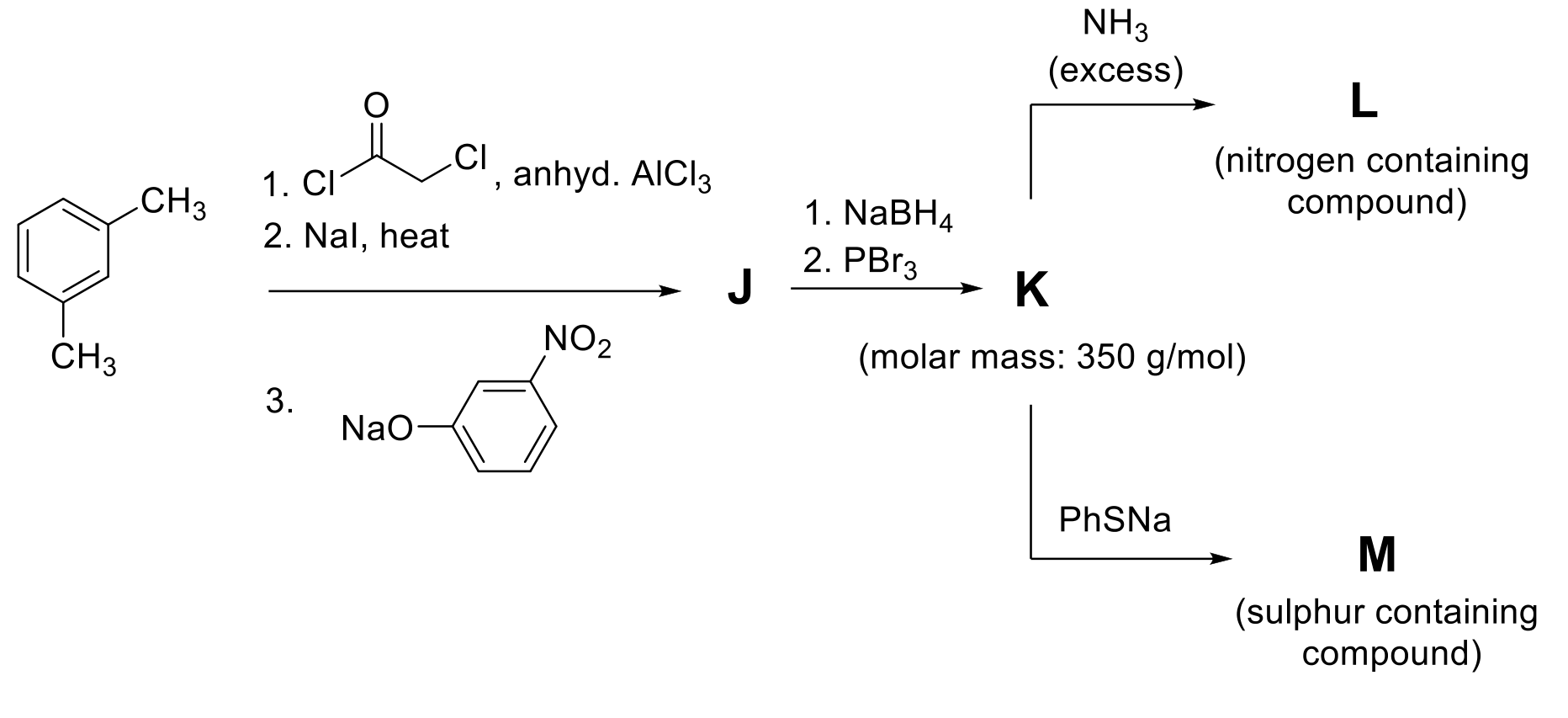
Consider the following reaction sequence in which J, K, L and M are the major products.

Given:
Atomic mass (in amu): H:1,C:12,N:14,O:16,S:32,Br:80,Ba:137\text{H}: 1, \text{C}: 12, \text{N}: 14, \text{O}: 16, \text{S}: 32, \text{Br}: 80, \text{Ba}: 137

In sulphur estimation by Carius method, the amount of BaSO4\text{BaSO}_4 formed from 3.79 g3.79\text{ g} of M is ______ g\text{g}.

Question Diagram 1
Official Numerical Answer2.33

Step-by-Step Solution

To determine the amount of BaSO4\text{BaSO}_4 formed in the Carius method, we first need to determine the structure and molecular formula of compound M.

Step 1: Reaction Sequence Analysis for J and K

  1. Friedel-Crafts Acylation: Reaction of mm-xylene (1,3-dimethylbenzene1,3\text{-dimethylbenzene}) with chloroacetyl chloride (Cl-CH2-CO-Cl\text{Cl-CH}_2\text{-CO-Cl}) in the presence of anhydrous AlCl3\text{AlCl}_3 yields 2-chloro-1-(2,4-dimethylphenyl)ethan-1-one2\text{-chloro-1-}(2,4\text{-dimethylphenyl})\text{ethan-1-one}: Ar-H+Cl-CH2-CO-Clanhyd. AlCl3Ar-CO-CH2Cl\text{Ar-H} + \text{Cl-CH}_2\text{-CO-Cl} \xrightarrow{\text{anhyd. AlCl}_3} \text{Ar-CO-CH}_2\text{Cl} where Ar=2,4-dimethylphenyl (C8H9)\text{Ar} = 2,4\text{-dimethylphenyl } (\text{C}_8\text{H}_9).

  2. Finkelstein Reaction: Treatment with NaI\text{NaI} converts the alkyl chloride to the alkyl iodide: Ar-CO-CH2ClNaI, heatAr-CO-CH2I\text{Ar-CO-CH}_2\text{Cl} \xrightarrow{\text{NaI, heat}} \text{Ar-CO-CH}_2\text{I}

  3. Ether Formation: Nucleophilic substitution with sodium 3-nitrophenoxide3\text{-nitrophenoxide} (NaO-Ar’\text{NaO-Ar'}, where Ar’=3-nitrophenyl\text{Ar'} = 3\text{-nitrophenyl}) yields compound J: Ar-CO-CH2I+NaO-Ar’Ar-CO-CH2-O-Ar’(J)\text{Ar-CO-CH}_2\text{I} + \text{NaO-Ar'} \rightarrow \text{Ar-CO-CH}_2\text{-O-Ar'} \quad (\mathbf{J})

  4. Reduction and Bromination:

    • Reduction of the carbonyl group of J using NaBH4\text{NaBH}_4 yields the secondary alcohol Ar-CH(OH)-CH2-O-Ar’\text{Ar-CH(OH)-CH}_2\text{-O-Ar'}.

    • Subsequent bromination using PBr3\text{PBr}_3 replaces the hydroxyl group with bromine to form compound K: J1. NaBH42. PBr3Ar-CH(Br)-CH2-O-Ar’(K)\mathbf{J} \xrightarrow{1.\ \text{NaBH}_4 \quad 2.\ \text{PBr}_3} \text{Ar-CH(Br)-CH}_2\text{-O-Ar'} \quad (\mathbf{K})

    • Molecular Formula of K: C16H16BrNO3\text{C}_{16}\text{H}_{16}\text{BrNO}_3

    • Molar Mass of K: MK=(16×12)+(16×1)+80+14+(3×16)=350 g/molM_{\mathbf{K}} = (16 \times 12) + (16 \times 1) + 80 + 14 + (3 \times 16) = 350\text{ g/mol} (This matches the given molar mass of 350 g/mol350\text{ g/mol}).


Step 2: Identification of Compound M

Compound K reacts with sodium thiophenolate (PhSNa\text{PhSNa}) in a nucleophilic substitution reaction where the bromine atom is replaced by the SPh-\text{SPh} group to yield compound M: KPhSNaAr-CH(SPh)-CH2-O-Ar’(M)\mathbf{K} \xrightarrow{\text{PhSNa}} \text{Ar-CH(SPh)-CH}_2\text{-O-Ar'} \quad (\mathbf{M})

  • Molecular Formula of M: C22H21NO3S\text{C}_{22}\text{H}_{21}\text{NO}_3\text{S}
  • Molar Mass of M: MM=(22×12)+(21×1)+14+(3×16)+32=379 g/molM_{\mathbf{M}} = (22 \times 12) + (21 \times 1) + 14 + (3 \times 16) + 32 = 379\text{ g/mol}

Step 3: Estimation of Sulphur by Carius Method

  1. Number of moles of M: Moles of M=Mass of MMolar mass of M=3.79 g379 g/mol=0.01 mol\text{Moles of } \mathbf{M} = \frac{\text{Mass of } \mathbf{M}}{\text{Molar mass of } \mathbf{M}} = \frac{3.79\text{ g}}{379\text{ g/mol}} = 0.01\text{ mol}

  2. Precipitation as BaSO4\text{BaSO}_4: Since 1 mole1\text{ mole} of M contains 1 mole1\text{ mole} of sulphur atoms, all sulphur from 0.01 mol0.01\text{ mol} of M is quantitatively converted to BaSO4\text{BaSO}_4: Moles of BaSO4 formed=Moles of M=0.01 mol\text{Moles of } \text{BaSO}_4 \text{ formed} = \text{Moles of } \mathbf{M} = 0.01\text{ mol}

  3. Molar Mass of BaSO4\text{BaSO}_4: MBaSO4=137+32+(4×16)=233 g/molM_{\text{BaSO}_4} = 137 + 32 + (4 \times 16) = 233\text{ g/mol}

  4. Mass of BaSO4\text{BaSO}_4 formed: Mass of BaSO4=0.01 mol×233 g/mol=2.33 g\text{Mass of } \text{BaSO}_4 = 0.01\text{ mol} \times 233\text{ g/mol} = 2.33\text{ g}

Final Answer: The amount of BaSO4\text{BaSO}_4 formed is 2.33 g\text{g}.

Amount of Barium Sulfate Formed in Carius Method of Sulphur Estimation | Chemistry PYQ Solution - JEE Challenger