Acidity Order of Phenol and Benzoic Acid Derivatives
The correct acidity order of the following is
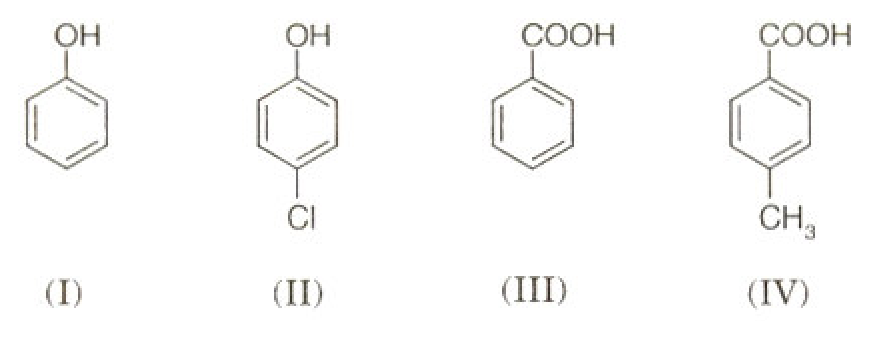
Options
Step-by-Step Solution
To determine the correct order of acidity among the given compounds, we analyze the relative acidities of carboxylic acids and phenols, and the effect of substituents on their stability.
The given compounds are:
- (I) Phenol ()
- (II) -Chlorophenol ()
- (III) Benzoic acid ()
- (IV) -Toluic acid ()
Step 1: Comparison between Carboxylic Acids and Phenols
Carboxylic acids are much stronger acids than phenols ( for benzoic acids, while for phenols). This is because the conjugate base of a carboxylic acid (carboxylate anion) is stabilized by resonance between two highly electronegative equivalent oxygen atoms:
In contrast, the conjugate base of a phenol (phenoxide ion) has its negative charge delocalized onto less electronegative carbon atoms of the benzene ring, making it substantially less stable. Therefore:
Step 2: Comparison between (III) and (IV)
- In benzoic acid (III), there is no substituent on the benzene ring.
- In -toluic acid (IV), the methyl group () at the para position acts as an electron-donating group through hyperconjugation () and positive inductive effect ().
- Electron-donating groups increase the electron density on the carboxylate group, thereby destabilizing the conjugate base and decreasing acidity.
Thus, benzoic acid is more acidic than -toluic acid:
Step 3: Comparison between (I) and (II)
- In phenol (I), there is no substituent on the benzene ring.
- In -chlorophenol (II), the chlorine atom has an electron-withdrawing inductive effect () that outweighs its resonance donating effect ().
- The net electron-withdrawing effect of chlorine stabilizes the phenoxide anion, making -chlorophenol more acidic than phenol.
Thus, -chlorophenol is more acidic than phenol:
Conclusion:
Combining the two comparisons, the overall acidity order is:
This corresponds to Option (A).