Acidic Hydrolysis of Enol Ether Molecule X and Identification of Statement Properties
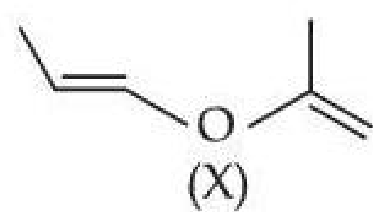
A molecule (X) with following structure under mild acidic condition is hydrolysed to produce (Y) and (Z). Identify the correct statements about (Y) and (Z).
A. Both (Y) and (Z) have same molar mass. B. (Y) and (Z) can be distinguished from each other by . C. (Y) and (Z) react with with same rates. D. (Y) and (Z) undergo addition reaction with 2,4-DNP.
Choose the correct answer from the options given below :
Options
A, B and C Only
B and C Only
C and D Only
A and D Only
Step-by-Step Solution
To determine the correct statements regarding compounds and , we first analyze the structure of molecule and its reaction under mild acidic conditions.
1. Acidic Hydrolysis of Molecule
Molecule is an unsymmetrical divinyl ether with the chemical structure:
Under mild acidic hydrolysis, the ether linkage undergoes cleavage to form two enols:
These enols immediately undergo tautomerization to yield their corresponding carbonyl compounds:
- (Propanal)
- (Propan-2-one / Acetone)
Thus, the products and are propanal and acetone.
2. Analysis of the Given Statements
-
Statement A: Both and have same molar mass.
- Both propanal () and acetone () share the same molecular formula, .
- Their molar mass is identical:
- Statement A is CORRECT.
-
Statement B: and can be distinguished from each other by .
- Sodium bicarbonate () reacts with carboxylic acids and strong acids to liberate gas, but it does not react with either aldehydes or ketones.
- Hence, neither propanal nor acetone reacts with , making it impossible to distinguish them using this test.
- Statement B is INCORRECT.
-
Statement C: and react with with same rates.
- Nucleophilic addition of depends on steric hindrance and the electrophilicity of the carbonyl carbon.
- Aldehydes (propanal) have less steric hindrance and a more electrophilic carbonyl carbon than ketones (acetone), making propanal react significantly faster with than acetone.
- Statement C is INCORRECT.
-
Statement D: and undergo addition reaction with 2,4-DNP.
- Both aldehydes and ketones contain the active carbonyl group () and react with 2,4-dinitrophenylhydrazine (2,4-DNP) via nucleophilic addition followed by elimination to form colored 2,4-dinitrophenylhydrazone precipitates.
- Statement D is CORRECT.
Conclusion
The correct statements are A and D Only.
Correct Answer: D