Acceleration of Rolling Solid Sphere Down Incline with Applied Forces
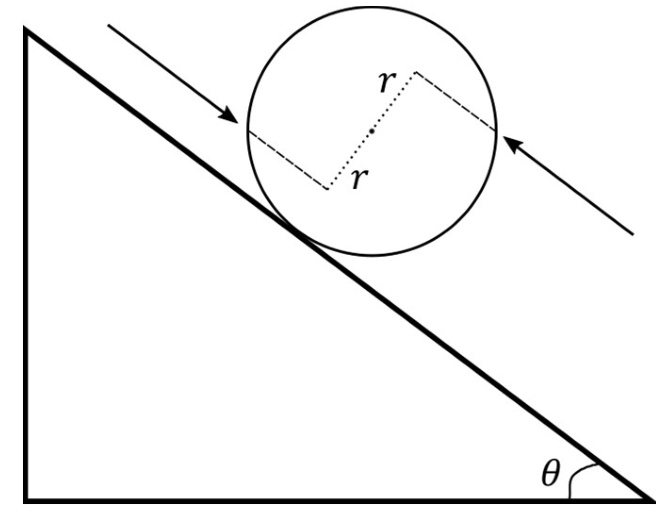
A solid sphere of mass and radius rolls without slipping on a fixed inclined plane with an angle of inclination from the horizontal. Two forces of magnitude each, parallel to the incline, act on the sphere, both at distance from the center of the sphere, as shown in the figure. The acceleration of the sphere down the plane is ______ . (Take .)
Topics & Concepts
Step-by-Step Solution
To find the acceleration of the solid sphere down the inclined plane, we analyze both its translational motion along the incline and its rotational motion about its center of mass.
1. System Parameters and Forces
- Mass of the solid sphere,
- Radius of the sphere,
- Distance of applied forces from the center,
- Angle of inclination,
- Acceleration due to gravity,
- Moment of inertia of the solid sphere about its center of mass,
From the given figure:
- The force acts at distance above the center, directed up the incline.
- The force acts at distance below the center, directed down the incline.
- The component of gravitational force down the incline is:
- Let be the force of static friction acting at the contact point, directed up the incline.
2. Equations of Motion
Translational Motion (down the incline):
Taking the direction down the incline as positive:
Substituting the given values:
Rotational Motion (about the center of mass):
Taking the clockwise direction (corresponding to rolling down the incline) as positive:
- Torque due to friction : (clockwise)
- Torque due to force : (counter-clockwise)
- Torque due to force : (counter-clockwise)
The net torque equation is:
For pure rolling without slipping, the condition connecting angular acceleration and linear acceleration is:
Substitute and into the torque equation:
Dividing by :
Substituting , , , , and :
3. Solving for Acceleration
Equating the expressions for from Equation 1 and Equation 2:
Thus, the acceleration of the sphere down the plane is (or approximately ).